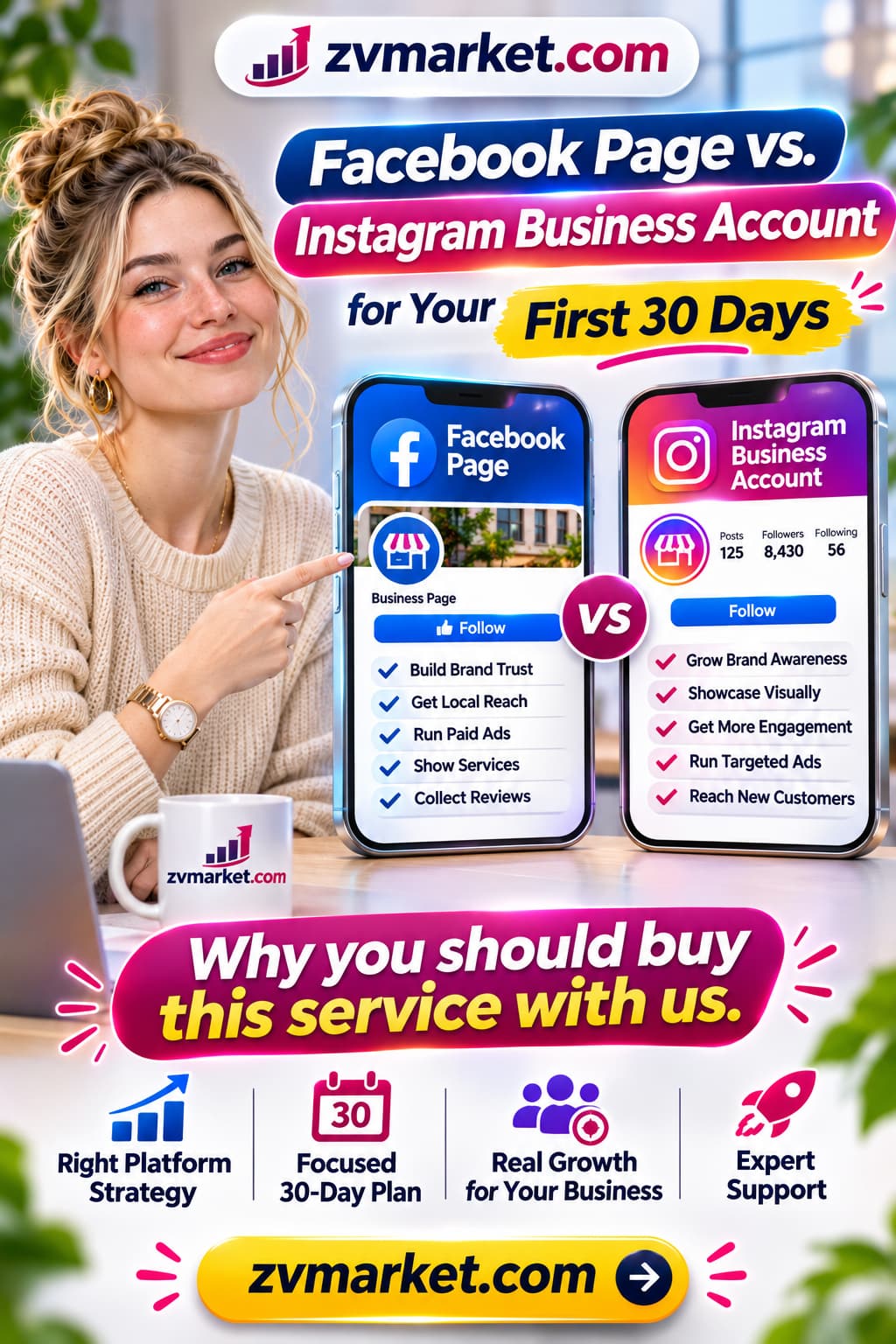
Facebook Page vs. Instagram Business Account for Your First 30 Days
-
November 27, 2026
A Facebook Page vs Instagram business account decision is easier when you tie it to one job for your first thirty days. A Facebook Page can be useful for a business whose customers look for hours, events, updates, and a contact route there. An Instagram business account can suit a team that can show products, work, or demonstrations visually and whose customers already use Instagram to discover businesses. Compare actual audience habits and what the team can maintain.
Start by writing down the action you want. A coffee shop may want people to find an opening date and get directions. A custom furniture business may want requests from people who saw an example of the work. If both channels can support the goal, choose the one where you can publish and answer messages reliably. A second channel can still carry an accurate basic profile without requiring an equal publishing schedule.
Compare the customer experience on each channel
A Facebook Page can give customers a place to check a location, opening hours, updates, and contact details. It may fit a business that serves a local audience that already asks questions or looks for events on Facebook. Test what an ordinary visitor can see and how they would contact you. Features can vary by the account and location, so confirm how the Page currently works rather than assuming a screenshot applies everywhere.
An Instagram business account can show a visitor a set of recent examples in a visual sequence. Reels, photos, and other formats can help illustrate what the business makes, how it works, or what customers need to know. Test whether the profile can make the actual offer obvious in a short bio. Make sure the contact route leads somewhere useful when a person wants more detail after seeing a post.
Assess your own capacity before opening both channels
List the types of content the team can produce with actual staff time. A visual product maker may have a steady supply of good photos, while a business with limited photography may be more comfortable with practical updates and frequently asked questions. Include time to handle messages and keep information current. An account can look active while inquiries wait in an inbox the team forgot to assign.
Check roles and ownership before connecting channels. Meta’s introduction to Business Suite explains how Meta’s tools can bring work across Facebook and Instagram together where supported. Hootsuite’s guide to linking Instagram and Facebook offers a walkthrough for connecting compatible profiles. Connecting them can make some workflows easier, but the channels still have different audiences and formats. Give each post a reason to appear where you publish it.
Use the first week to set up a reliable profile
Complete the basic information for the account you will use most. Confirm the business name, description, category, public hours where applicable, and destination link. Test the contact route on a phone. Decide who can change account details and who answers messages. Draft an introduction and one post that answers a common question about what you offer.
For the secondary account, prioritize accurate information and set a simple expectation. If messages are handled elsewhere, direct visitors to the right channel. Keep ownership and recovery details in the business’s approved system. That setup gives customers a useful profile when they look you up and gives your team room to learn how to run one channel well.
Use weeks two and three to test different jobs for posts
Publish a small sequence of posts. One can explain the offer, one can answer a question, and one can show a real example. Tailor format and wording to the visitors you expect. A service business might post a short demonstration on Instagram and an availability update on Facebook. The goal is to see which material helps people understand the business or choose the next action.
Give every post a clear purpose and record it. Note when it was published and how people replied or clicked. Compare the questions visitors ask with information on the profile. If people repeatedly ask for hours after seeing a post, move those hours closer to the first screen. If the best response is from a practical example, plan another example instead of just repeating the successful headline.
At day thirty, decide what to continue
Review relevant messages, contact actions, and profile or site clicks where the tools support them. Compare them with the outcome you chose before launch. A channel with many views can be less useful for a small business than a channel that produces a few relevant conversations. Look at quality and workload alongside volume. The team should be able to explain what the account achieved and what it took to maintain it.
Use the review to make one decision. Continue with the main channel, change the profile link, test a new content format, or give the secondary channel a small experiment. Document what you observed and when you will review it again. A first month of real activity gives you more useful information than an abstract debate about which platform is best for all businesses.
Before the next month begins, check the public contact route on both channels again. An unattended secondary account should still point visitors to somewhere they can get a reliable reply.
When to buy professional setup support
Consider ZvMarket’s Social Media Setup service if you need help setting up Facebook and Instagram around consistent business information and a clear contact route. Buying support can save time when ownership, profile copy, and presentation are scattered. Tell the team which channel will be primary and what you want visitors to do. Confirm the work included and who will keep both profiles up to date after launch.
If the first month includes a real launch or partnership with broader news value, consider ZvMarket’s press release distribution service for the public announcement. Buying distribution support can provide a separate way to share approved facts and review where they appeared. Use social posts to answer customer questions and direct people to the relevant page. Confirm the audience and reporting for distribution before buying it.
You May Also Like
-
Nov 27, 2026
Deciding what to post first is easier when you think about what a stranger needs from a new business account....

-
Nov 27, 2026
To write an Instagram bio customers can find and use, explain what your business does in the words those customers...
-
Nov 27, 2026
To set up a Facebook Business Page customers can find and trust, begin with the information they need before they...
-
Nov 27, 2026
A social media setup checklist gives a new business a clear order of work. Start with the people you want...
Sign up to receive our latest updates
Get in touch
Address
108 Imperial Ave, Winnipeg, MB R2M 0K7, Canada
Wolf@zvmarket.com
