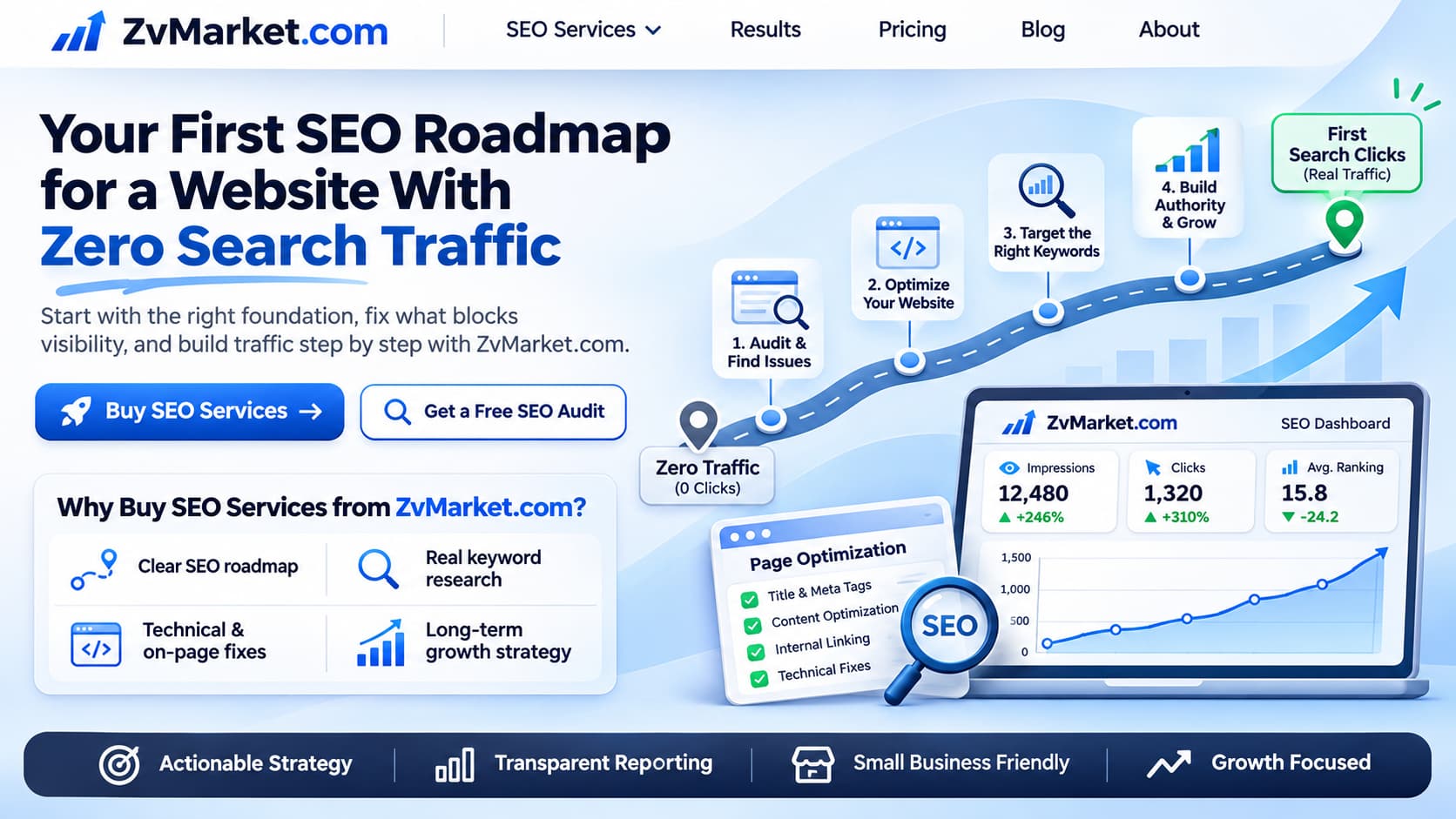
Your First SEO Roadmap for a Website With Zero Search Traffic
-
November 27, 2026
An SEO roadmap gives a site with zero search traffic a sensible order of work. You need pages that search engines can discover, answers customers actually want, and a way to tell whether you are reaching the right people. Start with work you can finish in the first three months. A small number of useful pages gives you more to learn from than a publishing calendar full of loosely related topics.
Before opening a keyword tool, name the audience, offer, and action you want to support. A bicycle repair shop might want bookings from commuters across two neighborhoods. A software company might want trials from freelance bookkeepers. Those goals lead to different pages and different measures of success. Write a simple sentence that links a customer problem to a page and an action. Use it to decide where your limited time goes.
Week one is for access and measurement
Verify the site in Search Console and inspect the homepage and a core service page. Check whether they load while you are signed out and whether Google can index the preferred versions. Remove accidental noindex settings only where you intend pages to be public and searchable. Check that important links point to the correct version of each URL. Submit a public sitemap if one exists, since it can help Google discover URLs. The sitemap itself does not ensure indexing.
Set up a simple sheet listing the public page, its business purpose, publication date, and indexed status. Add columns for impressions, clicks, and an outcome such as a form submission or call. If several different people work on the site, agree who will record changes. A new site with zeroes still has a baseline. The Ahrefs SEO basics guide covers the fundamentals, and Google’s Search Console overview shows where to find the key reports.
In weeks two and three, decide which pages to publish first
Make your homepage and one or two core offering pages useful before building a large blog. Explain what you sell, who it is for, and what to expect after a visitor requests information. If the work is priced per job, explain which details affect cost and tell the visitor what they should have ready. Give every core page a clear title, an accurate primary heading, and an accessible path from the homepage or a services hub.
Collect real wording from calls, emails, and conversations. Search some of these phrases and look at the page formats that appear. A person searching for made-to-measure dining tables might want to compare examples and request a quote. A person asking how much room to leave around a dining table needs a measurement guide. Give each query a destination that serves its task. If two phrases ask for the same answer, cover them naturally on one page.
Build useful proof into your first pages
A new website can use evidence from the business it represents. A contractor can show a real work sample with permission and explain the material and constraint involved. A software founder can show a product workflow using a demonstration account. A consultant can share a redacted example of the sort of report clients receive. Each piece of evidence should help a reader make a decision or understand an important step.
Publish one supporting article when you can answer a related question well. For the furniture business, a guide can show readers how to measure around existing chairs and allow for a walkway. The service page can link to the guide where it asks for dimensions. The guide can link to the service when a reader has a space that requires custom measurements. This gives each page a role and helps visitors move between them without guessing.
At the end of month one, see what search is finding
Open the Performance report and review pages and then queries. Look for recurring impressions that match the page’s purpose. One impression can be noise. A phrase that appears in several weeks can justify a closer look at the results. Record when you add content, change a title, or link to a page so you can compare future activity against a timeline.
For a page that shows no visibility, check indexability and internal discovery first. For a page attracting irrelevant queries, review how the opening and headings describe its purpose. If a page appears for useful searches but gets few visits, inspect its position and the result layout before rewriting the snippet. If it receives visits and few inquiries, ask whether the offer and next step are easy to understand.
Use months two and three to build on the first signals
Choose two or three priority pages and give each one a specific improvement. That might mean adding a proof point, explaining a pricing variable, or showing a process on mobile. Publish a second article when your first pages reveal a new question customers keep asking. Share genuinely useful resources with partners or groups that serve the same audience, and record the referrals and mentions that follow.
Keep the roadmap small enough to revise. Review indexed pages, relevant impressions, contact actions, and the content changes you made. If most useful searches are for one core offer, explore that offer’s related questions before opening an unrelated topic. For a business with a long sales cycle, include leading measures such as quote starts alongside completed purchases. A short review at the end of each month gives you evidence to choose the next month’s work.
A useful first-quarter checkpoint is whether someone new to the business can find the right page from the homepage and complete the intended action on a phone. Ask one person to try it without instructions. Write down where they hesitate and fix the most obvious barrier before expanding the site.
When the SEO roadmap reaches promotion
Once a core page is ready to share, consider ZvMarket’s First Page Formula package for manual link-building support. Buying support can make sense when your team can build a useful page but lacks time to research relevant sites and evaluate placements. Give the campaign a specific audience and a priority URL so the work has a measurable purpose. Ask what placements and reporting are included before buying, and use your Search Console baseline to evaluate progress over time.
You May Also Like

-
Nov 27, 2026
Real estate blog topics for sellers work best when they help homeowners make a decision before they contact an agent....
-
Nov 27, 2026
Topic clusters help a small website organize related pages around one reader need. A good cluster has a clear starting...
-
Nov 27, 2026
A small website can outrank big brands when it answers a specific search more completely and credibly. The opportunity usually...
Sign up to receive our latest updates
Get in touch
Address
108 Imperial Ave, Winnipeg, MB R2M 0K7, Canada
Wolf@zvmarket.com
