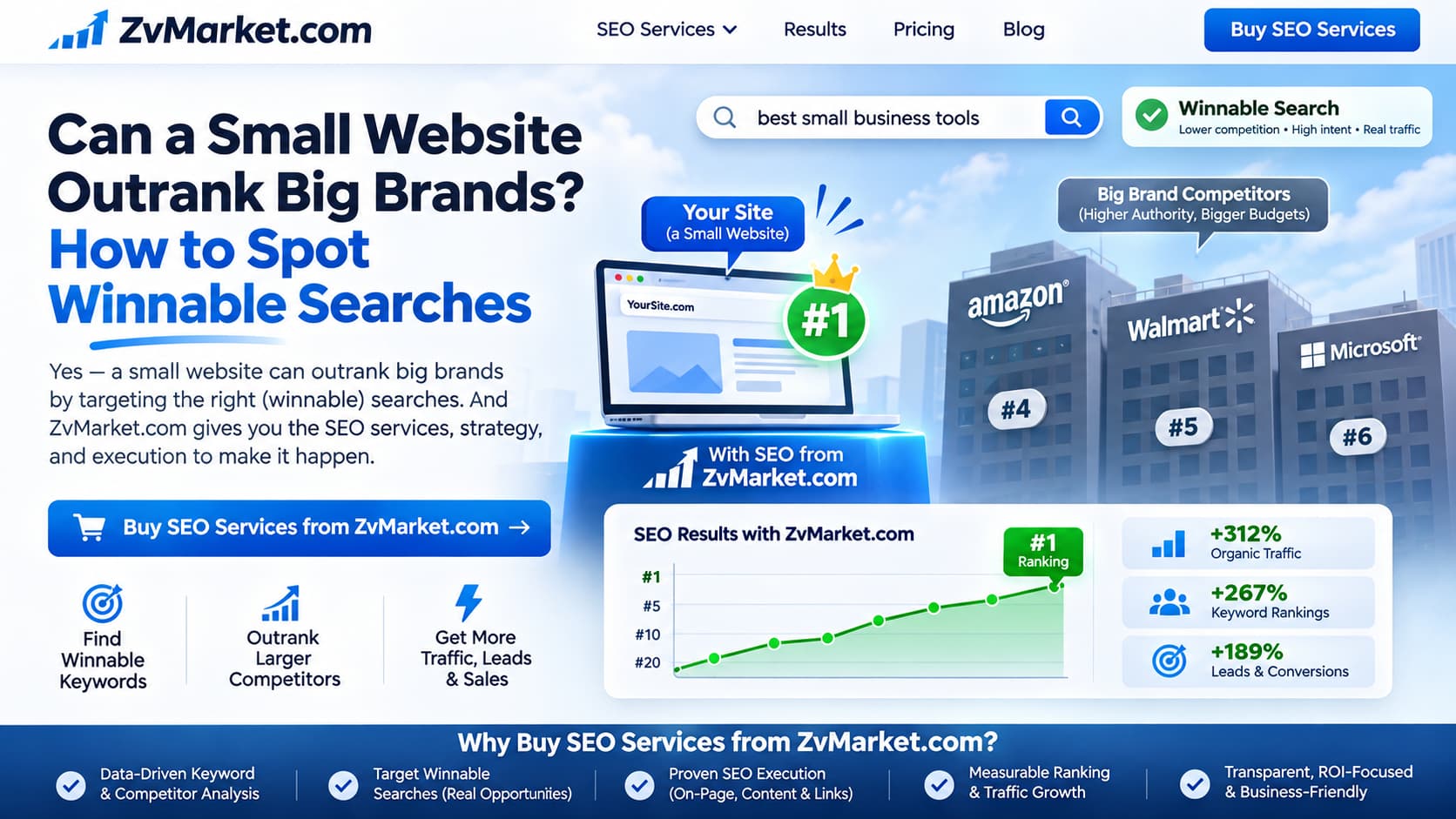
Can a Small Website Outrank Big Brands? How to Spot Winnable Searches
-
November 27, 2026
A small website can outrank big brands when it answers a specific search more completely and credibly. The opportunity usually appears where the broad pages already ranking are only loosely relevant to the question. Your job is to identify a real customer problem, find a results page that leaves room for a better answer, and publish evidence that a larger site may have overlooked.
Use this guide to reading Google’s first page for keyword research to compare the strongest results before choosing a topic.
Imagine a retailer with one employee who repairs espresso machines. A national brand can publish a long guide to espresso machines. The retailer may have a better answer to “why does my espresso machine leak after descaling” because the team has diagnosed that issue repeatedly. The topic is narrower, the reader’s goal is clearer, and the business can supply photos or steps based on experience.
Start with specific problems your customers already describe
Read support messages, sales notes, reviews, and community threads with permission where appropriate. Look for recurring problems, specifications, and moments when people have to choose between options. Write down the language people use. Keep the whole phrase if it identifies a meaningful constraint, such as a small space, a particular platform, a limited budget, or a tricky repair.
Your first list might include fifteen phrases. Combine phrases that need the same answer and separate those that lead to different decisions. “Home office desks for narrow rooms” and “how to measure a home office for a corner desk” share a subject, but the first may favor a comparison and the second may favor a measurement guide. Publishing two nearly identical pieces would dilute the effort. Distinct assignments are easier to write and measure.
Spot searches where a small website could outrank big brands
Search each phrase in your target market. Scan the pages that rank. A forum thread, a small specialist site, or an older page can suggest an opening, depending on why it ranks. Read both the large brands and smaller pages. Look at whether they cover the exact situation, how much evidence they provide, and what question readers still have after scrolling.
Three observations are particularly useful. A broad guide may mention your topic in one paragraph. A dated page may miss a current product or workflow. A ranked page may describe what to do without showing how to do it. A weak result on its own says little. An opening is stronger when several results leave the same useful detail unexplained and you can supply it.
The Ahrefs guide to low-competition keywords explains why automated difficulty scores work best as an initial filter. Check the results yourself before committing to a brief. Link-based difficulty can indicate how competitive a result set may be, but it cannot tell you whether your team has the expertise to make a better page.
Choose a problem you can demonstrate
The best advantage is something you can show. Use annotated screenshots, a short original test, a small dataset, photos of a real problem, or examples with clear assumptions. A home-improvement contractor might show how a certain material behaves in a damp basement. A software consultant might document a migration that preserves settings and explain where the official procedure falls short for a specific version.
Design the page around the reader’s next decision. Open with a direct answer. Explain when it applies, provide steps, and make the exceptions visible. For a how-to page, test the instructions from the beginning. For a comparison, explain how you selected and evaluated alternatives. Google’s guidance on people-first content is a useful reminder to make your audience and evidence clear.
You can also make a narrow page worth citing. A simple compatibility table, a photographic troubleshooting guide, or an editable worksheet gives other sites a concrete reason to reference it. Choose something that can be maintained. A thin page containing fifty keyword variations is harder to keep useful than one resource you can update when the product or workflow changes.
Give the page a place in your site
Add internal links from a relevant product category, support hub, or article. Make each link useful at the point where a reader needs more detail. Where possible, use the same stable address in your navigation, sitemap, and body links. When you publish supporting pages, give each one a specific role and connect them where it helps the reader move from diagnosis to action.
For the espresso machine example, the leak article can link to a descaling guide and an explanation of common seal failures. Those pages can point back where they describe the same symptoms. This helps people browse related problems and helps a small site communicate what it knows. A useful cluster is a set of related answers, each built for a genuine problem.
Decide whether the traffic would be useful
An attainable ranking is only worth pursuing if the audience matters to your business. Ask whether a reader might book a repair, choose a product, request a quote, or join a newsletter. Identify the most relevant action and make it available without interrupting the answer. A low-volume query that produces relevant inquiries can be more valuable than a broad topic that attracts casual visitors.
After publishing, use Search Console to see which variations earn impressions and whether the traffic matches the brief. Follow the query over a consistent date range and compare against similar pages on your own site. Update the piece when user questions reveal a useful gap. If the traffic never fits your offer, move the next article closer to the problem your customers pay you to solve.
For a first publishing batch, choose three topics you can support with distinct examples. An editorial calendar built around three concrete problems lets you compare which audiences respond and which pages lead to useful conversations. Revisit the candidate list after a few weeks of evidence, especially if an unexpected variation suggests a stronger follow-up topic.
When to commission manual link-building support
If you have a specialist resource that clearly earns its place in the results, consider ZvMarket’s first-page SEO link-building service. Buying this service can free a small team to keep producing firsthand content while someone else works on manual outreach and relevant placements. Start with the resource and explain which sites might genuinely benefit from citing it. Define what you consider a relevant placement and ask how each one will be documented. A targeted campaign is easier to evaluate when it supports one clear page and audience.
You May Also Like

-
Nov 27, 2026
Real estate blog topics for sellers work best when they help homeowners make a decision before they contact an agent....
-
Nov 27, 2026
Topic clusters help a small website organize related pages around one reader need. A good cluster has a clear starting...
-
Nov 27, 2026
An SEO roadmap gives a site with zero search traffic a sensible order of work. You need pages that search...
Sign up to receive our latest updates
Get in touch
Address
108 Imperial Ave, Winnipeg, MB R2M 0K7, Canada
Wolf@zvmarket.com
