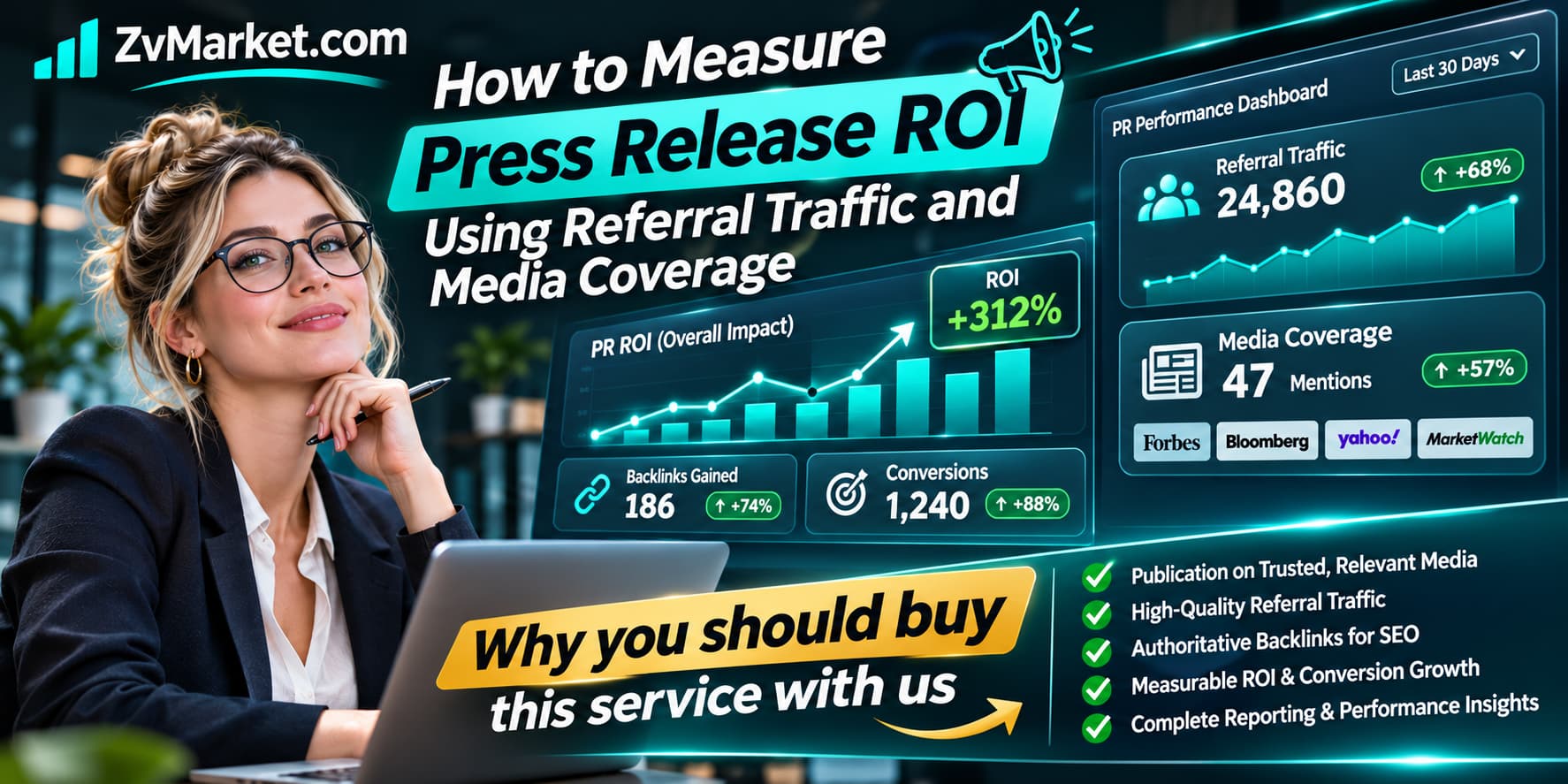
How to Measure Press Release ROI Using Referral Traffic and Media Coverage
-
November 27, 2026
Press release ROI begins with a definition of what the announcement was supposed to achieve. The campaign might aim for relevant news coverage, visits to a new product page, inquiries from partners, or some combination. Those outcomes are not interchangeable. A large list of syndicated copies may show distribution activity, and a few visits from a specialist publication may be valuable because they lead to the right action. Plan the measurement before the release goes out.
Write down the objective, audience, release date, destination page, and review window. Establish who owns each measure and what you can collect under your analytics and consent setup. Record the costs you are evaluating, such as writing, design, distribution, outreach time, and reporting. Decide which costs are actual charges and which are estimated staff time. Use the same definitions in the final discussion.
Separate outputs from changes in audience behavior
An output can be an announcement distributed, a syndicated copy, or a verified independent article. An outcome can be a referral visit, a demonstration request, a sales conversation, or another action tied to your goal. AMEC’s Integrated Evaluation Framework gives a way to think through activities, outputs, outcomes, and impact. Start by separating things the team produced from evidence that someone used or responded to them.
Build a coverage log with date, outlet, link, type, and notes about the audience. Label syndicated release copies separately from reported stories, newsletters, interviews, and social mentions. Save direct links where possible and identify duplicates that reuse the same underlying item. Explain estimated reach as an estimate. It is different from the number of actual readers who opened a page or visited your site.
Track referrals and campaign links where possible
Choose one useful destination that is ready for readers. Use campaign parameters when you can control the link and can apply them consistently. A documented naming convention makes the campaign easier to find during reporting. Use Google Analytics guidance on campaign URLs to understand what supported parameters describe. Test that a tagged link lands on the correct page and stays usable after redirects.
Independent articles may use untagged links or omit links entirely. Review referral sources and note the publication dates. Some visitors may search for the brand, return later from another device, or decline analytics. That traffic may be challenging to connect to the release. Report what you can observe and label possible indirect effects separately. Keep campaign links free of personal information.
Measure actions on the destination page
A page built for the announcement should make the intended action obvious. For a product launch, that might be opening a demo page or asking for a trial. For a partner announcement, it might be sending a business inquiry. Check that the event is triggered on successful completion and that a failed submission does not look like a conversion. Use test data and record how you validated the setup.
Review traffic quality along with visits. A small specialist publication may attract readers who spend time on a useful resource and click through to learn more. A large syndicated network may add many placements but little referral activity. Use the campaign purpose to decide which result matters. Track relevant inquiries separately from clicks that may simply reflect curiosity.
Compare with a baseline and explain uncertainty
Pick a period before launch to describe ordinary referral visits, branded search interest, and conversion volume where available. Compare it with a similar period after publication. Note other activity, such as paid ads, newsletters, seasonality, or a product event. Those can affect the same numbers. A short spike close to launch is worth investigating, but timing alone cannot prove that the release caused it.
For example, imagine a release costs a total of $1,000 and four campaign visits become qualified inquiries under the measurement rules. That would be $250 in tracked campaign cost per qualified inquiry. It is a cost efficiency measure. A financial ROI calculation also needs credible attributable benefit, such as incremental profit linked to the campaign. If the evidence does not support a profit estimate, report the measurable outcome and explain what is still uncertain.
Present the result as a learning report
Keep a summary of the objective, cost, verified coverage, relevant referrals, conversion evidence, and caveats. Include a short list of the publications or partners that reached the most relevant audience. Separate observation from interpretation. A report can say that a trade site sent a specific number of visits and that some completed actions. It should avoid claiming that every visit or later sale happened because of the release.
Use the findings to choose a concrete next step. If topically relevant placements led to useful visits, focus future outreach on comparable audiences. If coverage existed but readers had no usable link or next action, improve the landing page and media materials. If tracking failed, repair the campaign naming or conversion configuration before buying another round of distribution.
Build a small reconciliation table after the first reporting window. Add a row for each source you observed, plus a row for activity you cannot reliably attribute. For each source, record the verified article link, the date, the observed visits, and the number of successful actions under your definition. If traffic data is missing for a publisher that did link, check whether the URL changed or the item appeared outside the reporting window. Leave unknown fields empty with a short explanation. Ask someone outside the campaign to double-check whether an entry is a confirmed outcome or an estimate. That makes the report easier to use when the team compares the next launch.
When to buy distribution with useful reporting
If you have a verified release and would benefit from distribution coordination and a record of placements, consider ZvMarket’s press release distribution service. Buying a defined package can make it easier to plan the submissions and reconcile a report against your own analytics. Give the team your launch objective, audience, and approved landing page. Ask what counts as a placement, which live URLs will be reported, and when you should expect the report before purchasing.
You May Also Like

-
Nov 27, 2026
Press release headline examples are useful when you can adapt the underlying structure to real news. A strong headline gives...
-
Nov 27, 2026
Press release distribution cost depends on what the provider is doing with your announcement. A quote for distributing a release...

-
Nov 27, 2026
To write a press release journalists can use quickly, give them accurate facts in an order that supports a quick...

-
Nov 27, 2026
Press release distribution vs media outreach is a planning decision for a product launch. Distribution gives multiple outlets access to...
Sign up to receive our latest updates
Get in touch
Address
108 Imperial Ave, Winnipeg, MB R2M 0K7, Canada
Wolf@zvmarket.com
