How to Write a Press Release Journalists Can Use in Five Minutes
-
November 27, 2026
To write a press release journalists can use quickly, give them accurate facts in an order that supports a quick decision. A busy editor should be able to identify the news, understand who it affects, and find someone who can answer questions. The five minutes in this title describe the reader’s first pass. Preparing and verifying a good announcement takes longer because useful copy depends on details the company can stand behind.
Start with a factual brief before drafting. Write down what changed, who is announcing it, who is affected, when it starts, where it applies, and what makes the news timely. If the announcement lacks an answer to one of those questions, assign someone to verify it. Record the correct spellings of names and numbers, and identify which facts come from publicly available information or an approved company source.
Write a headline that tells readers what changed
Use a simple subject and verb. A fictional example would be “North Shore Repair Opens Second Workshop in Everett.” That tells a reader much more than “North Shore Repair Announces Exciting Expansion.” The headline can also state an important scope detail if it fits. A useful subheading might explain which services the new workshop will offer or when it starts taking appointments.
Read the headline in isolation. A recipient should be able to describe the news without opening the full release. Avoid claims such as first, biggest, or fastest unless the team can supply evidence and state the scope. A clear headline makes it easier for a journalist to decide whether the announcement is relevant to the publication and to identify follow-up questions.
Put the important facts in the opening paragraph
Use the first paragraph to establish the organization, action, location, date, and practical result where those facts are relevant. Give a reader enough information to understand why the item is news. For a product release, say who can use it, what has changed, and when it becomes available. Put the broader significance into a follow-up sentence if the first paragraph becomes crowded.
Use the rest of the release to answer questions in roughly decreasing order of importance. Add scope, availability, product details, partner roles, or the relevant background. Keep one main idea per paragraph. PRSA’s guide to writing a release that earns coverage gives an editorial perspective on why releases need a clear story and usable information. A reader should be able to stop after the opening and still understand the essential facts.
Give each quote a job
A quote works when it adds perspective, explains a decision, or makes the practical significance easier to understand. Ask the speaker what problem led to the announcement and what needs to happen next. Confirm the wording, name, and title with the speaker. A short, specific comment can be quoted cleanly or used as a starting point for an interview. Generic enthusiasm rarely answers a reporter’s question.
When you include a number, make it possible to check. Specify the period, source, and what the number measures. If you use survey data, give a brief description of the sample and link to usable methodology or include it in the press materials. Distinguish a company’s intentions from verified outcomes. If a fact changes shortly before distribution, update the release, press page, and talking points together.
Add assets and a contact who can respond
Provide links to approved photographs, logos, demo materials, or fact sheets where useful. Explain what the recipient may use and give credit information where required. Check that links open without asking for access. Use descriptive file names and make files easy to download. Business Wire’s guide to improving the release reader experience offers ideas for making supporting materials easier for recipients to use.
Close with a short, factual description of the organization and a media contact. Give the contact a name, an appropriate email address, and any practical availability details. Brief that person on the announcement before distribution. If the release is sent across time zones, share the time reference clearly. Make it possible for a recipient to ask a question and receive a reliable answer before their deadline.
Run a five-minute editorial test before sending
Give the draft to a colleague who was not part of the launch. Ask them to find the news, the effective date, one useful quote, a source for the main claim, an approved image, and the media contact. Note what they cannot find immediately. Verify that names match across the release and support material. Test the links and check the release on mobile before approval.
Change the draft based on what the colleague misses. If they can repeat the headline but cannot explain who benefits, improve the first paragraph. If they cannot verify a number, add the source or use a narrower claim. If they know the product but cannot tell when it is available, move that detail higher. A fast review is valuable because it exposes gaps the writing team may have learned to overlook.
Use a short approval log for changes after the test. Record who approved quotes and numbers, which version the media contact has, and where the final link points. This is useful when a partner needs to confirm which draft is current. Keep the latest version easy to identify so two teams do not send different versions by accident.
Do a final editorial read after copying the approved draft into the distribution platform. Paragraph breaks, links, image captions, and punctuation can change across editors. Check the rendered release and ensure that media assets open from the version recipients will actually see.
When writing and distribution support is worth buying
If a launch needs a clear release and your team has limited time for writing, submissions, and follow-up, consider ZvMarket’s press release distribution service. Buying support can help establish an orderly process around approved facts, useful assets, and distribution reporting. Bring a short brief, contact details, and verified claims. Ask which writing, review, and placement reporting are included before buying, and keep final approvals with the people responsible for the announcement.
You May Also Like
-
Nov 27, 2026
Press release ROI begins with a definition of what the announcement was supposed to achieve. The campaign might aim for...
-
Nov 27, 2026
Press release headline examples are useful when you can adapt the underlying structure to real news. A strong headline gives...
-
Nov 27, 2026
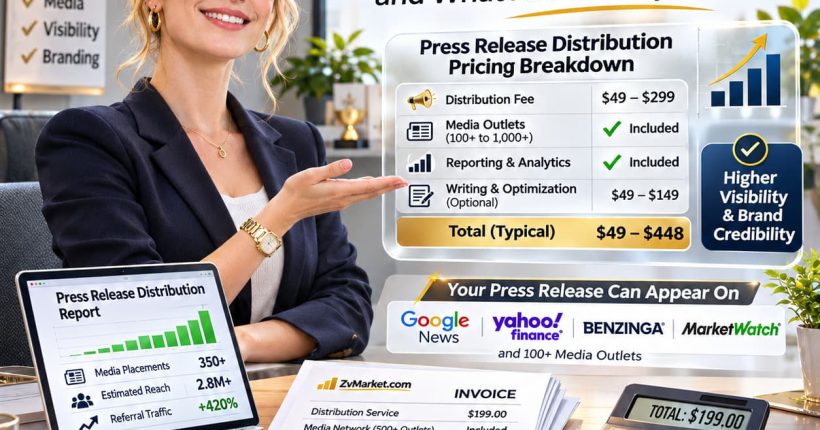
Press release distribution cost depends on what the provider is doing with your announcement. A quote for distributing a release...

-
Nov 27, 2026
Press release distribution vs media outreach is a planning decision for a product launch. Distribution gives multiple outlets access to...
Sign up to receive our latest updates
Get in touch
Address
108 Imperial Ave, Winnipeg, MB R2M 0K7, Canada
Wolf@zvmarket.com
